


Amendment 3: What It Means If You Own Florida Property You Don't Live In
Rentals, second homes, commercial buildings, and the reset that comes with a sale
If you own a Florida rental, a second home or a commercial building, Amendment 3 would give you no exemption at all. What it would give you is a lower cap on how fast the assessed value of that property can rise for county and city taxes, 5 percent a year instead of 10.
Voters decide today, November 3. The amendment needs 60 percent to pass. Most of what follows matters whichever way the vote goes.
The homestead side of the amendment drew most of the attention, and it's large. It would cut county and city property taxes for people who live in their homes, and it would limit what counties and cities may spend property tax money on. For owners of everything else, the amendment would change one number. That one number would change what happens when the property, or the company that owns it, is sold.
What changes, and what doesn't
Amendment 3 is CS/HJR 1-F, the joint resolution the Legislature passed in its June 2026 special session by votes of 75–26 in the House and 30–9 in the Senate. It would amend Article VII, sections 4, 6 and 9 of the Florida Constitution. If 60 percent of voters approve it, it takes effect January 1, 2027, and the first bills reflecting it arrive in November 2027.
Most of the coverage has been about homeowners. For property you don't live in, the list of changes is short.
| Today | Under Amendment 3 | |
|---|---|---|
| Annual cap on assessment increases, non-homestead residential and commercial (non-school levies) | 10% | 5% |
| Cap on school levies, non-homestead | None. Taxed on full just value | None. Unchanged |
| Reset to just value after a sale or change of control | Yes, the next January 1 | Yes. Unchanged |
| Homestead exemption, non-school levies (permanent residents as of Dec. 31, 2026) | About $26,400 on top of $25,000 | Up to $150,000 in 2027, $250,000 in 2028, indexed from 2029 |
| Homestead exemption, non-school levies (residents on or after Jan. 1, 2027) | Same as everyone | Up to $50,000 until the fifth year of the exemption, then the full amount |
| Exemption for second homes, rentals, commercial | None | None |
| What counties and cities may spend property tax on | Any valid purpose | A list: public safety, schools, infrastructure, natural resources, bonds, pensions and government operations |
Sources: Florida Senate bill summary, CS/HJR 1-F; Pinellas County Property Appraiser (current non-school add-on of $26,411 for 2026). The cap change sits in Article VII, sections 4(g) and 4(h), implemented today by sections 193.1554 and 193.1555, Florida Statutes.
Two things don't move at all. School taxes on non-homestead property stay uncapped, so a large share of a commercial owner's bill still tracks market value. And no part of the amendment touches millage rates, which local governments still set every year.
The savings stay with the property until it changes hands
A lower cap only matters when values rise faster than the cap. When they do, the assessed value falls further behind market value every year. That gap is the owner's savings, and it lasts exactly as long as the ownership does.
Take a commercial building with a just value of $10 million whose market value grows 8 percent a year. Under today's 10 percent cap, assessed value keeps pace with the market and there's no gap. Under a 5 percent cap, after five years the building is worth about $14.69 million but assessed at about $12.76 million.
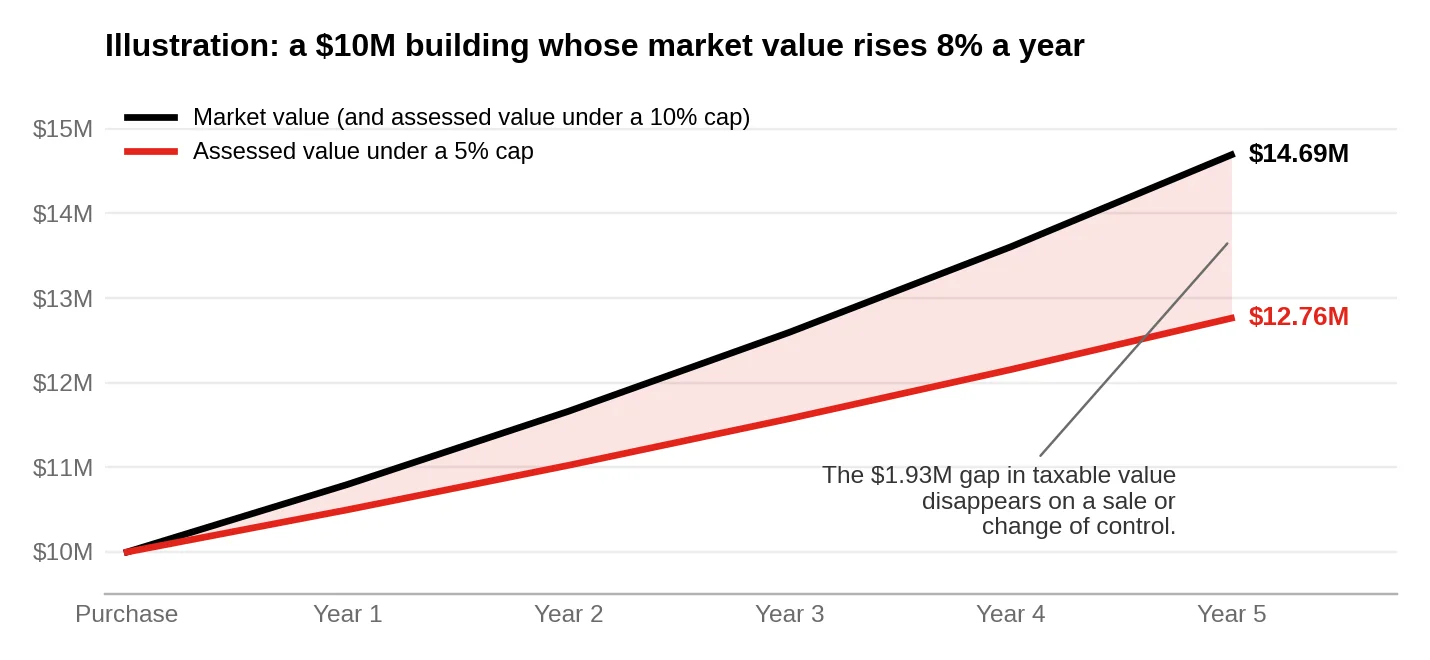
The gap disappears on a change of ownership or control. The property is reassessed at just value on the next January 1 after any sale, foreclosure, transfer of legal title, or transfer of beneficial title in equity. § 193.1555(5); § 193.1554(5). It also happens on "the cumulative transfer of control or of more than 50 percent of the ownership of the legal entity that owned the property when it was most recently assessed at just value." § 193.1555(5)(b). So selling 51 percent of the LLC that owns the building resets the building, even though no deed is recorded. The same is true of three 20 percent sales spread over several years.
The two triggers are separate. A deed of the property itself resets it, whatever share of the owning company changes hands. The 50 percent test applies only to transfers of the company. Garcia v. Piper Indus. Complex, LLC, 419 So. 3d 700 (Fla. 3d DCA 2025).
The exceptions are narrow. A transfer to correct an error, a transfer between legal and equitable title, and trading in the shares of a publicly traded company don't count. § 193.1555(5)(b)1.–3. A merger or acquisition of a public company does. For residential property of nine or fewer units, a transfer between spouses is also excluded. § 193.1554(5)(c).
When the change isn't recorded by deed, the owner has to tell the property appraiser "promptly." § 193.1556(1). An owner who doesn't, and is caught, owes the taxes avoided for up to 10 prior years, plus 15 percent interest a year and a penalty of 50 percent of the taxes avoided. Id. The property appraiser records a tax lien against that owner's property in the county, and in any other Florida county where the owner holds property. Id.
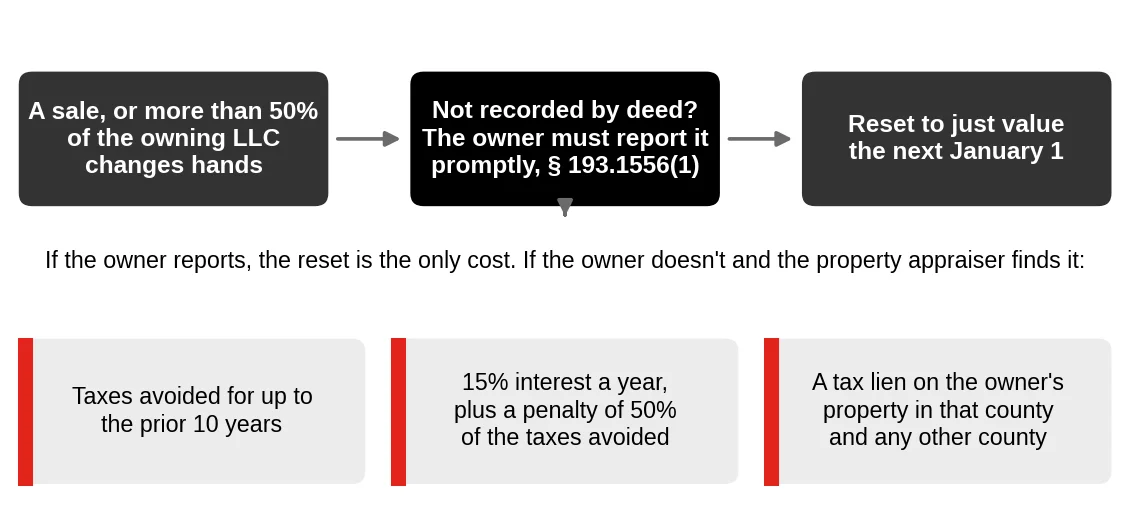
Amendment 3 wouldn't change any of those rules. It would make them more expensive to forget.
What nobody knows yet
Whether your tax bill actually goes down. The cap limits assessed value, not tax. Local governments still set millage rates every year, and they will be setting them with less to work with. The Revenue Estimating Conference projected that the amendment would cut local non-school property tax revenue by $4.95 billion in fiscal year 2027–28, $8.78 billion in 2028–29, and $11.86 billion a year once fully phased in. House Final Bill Analysis, CS/HJR 1-F (June 16, 2026). Homesteads absorb most of that relief. Rentals, second homes and commercial buildings are what's left on the roll. The Pinellas County Property Appraiser expects the familiar "rolled-back rate" on 2027 TRIM notices to work instead as a rolled-up rate, the highest millage a taxing authority could adopt without collecting more than the year before. Whether counties and cities go that high is a 2027 budget question.
What the implementing law will say. The amendment would direct the Legislature to adopt procedures by general law, including a uniform procedure for counties and cities to raise the homestead exemption further. Administrative details for non-homestead property, such as how the 5 percent cap phases in on January 1, 2027, are likely to be settled there.
Whether the new-resident rule survives. People who become Florida residents on or after January 1, 2027 would get a $50,000 exemption until the fifth year of their exemption, while earlier residents would get up to $250,000. Florida has been here before. In 1982 the Florida Supreme Court struck down a statute that limited a larger homestead exemption to people who had lived in Florida for five years, holding that the state may not "impose different taxes on its citizens based solely on their length of permanent residence." Osterndorf v. Turner, 426 So. 2d 539 (Fla. 1982). That case involved a statute, and this rule would be in the constitution itself, so the state-law question is different. The federal one isn't. The U.S. Supreme Court struck down a property tax exemption limited to people who were residents before a fixed date, Hooper v. Bernalillo County Assessor, 472 U.S. 612 (1985), and upheld California's system of taxing property by when it was bought, Nordlinger v. Hahn, 505 U.S. 1 (1992). Amendment 3 keys the smaller exemption to when a person became a resident, not when the property was bought. That is where we expect the fight to be.
What "operations and administration" covers. The amendment would limit county and city property tax revenue to a list of uses. The last item on the list would cover the operations of county officers and governing bodies and the expenditures they approve, "except as otherwise prohibited by general law." How much that leaves out depends on what the Legislature later prohibits.
For owners of rentals, second homes and commercial buildings
This includes owners who live abroad. A Florida condo or office building owned by a non-resident, or by a company, can't be homesteaded under the amendment or under current law. If the amendment passes, the 5 percent cap is the only relief on offer.
- Know your reset date. For each property, find the January 1 it was last assessed at just value and who owned the entity then. The 50 percent count under § 193.1555(5)(b) runs from that date and adds up every transfer since.
- Run the numbers before you bring in a partner. Admitting an investor, buying out a co-owner, or moving interests to the next generation can cross 50 percent in stages. Moving a property from your own name into your own LLC counts too. The Third District held that a married couple's transfer of a rental property to their wholly owned LLC reset its assessment, and declined to create an exception the statute doesn't contain. S & A Prop. Inv. Servs., LLC v. Garcia, 360 So. 3d 432 (Fla. 3d DCA 2023).
- Look back 10 years. If an interest in your company changed hands without a deed and nobody told the property appraiser, the exposure is the avoided tax, 15 percent interest, and a 50 percent penalty, secured by a lien. § 193.1556(1).
- Ask before you restructure a foreign parent. Many foreign owners hold Florida property through a holding company abroad. Changes at that level can still be a change of control. Have the structure reviewed before the transfer, not after.
- Read the August 2027 TRIM notice. If the amendment passes, it's the first one that will reflect it, and the deadline to challenge your assessment before the value adjustment board runs from it.
For buyers, sellers and commercial tenants
Buyers should underwrite the tax bill they will get, not the one the seller has. After closing, the property resets to just value on the next January 1. § 193.1555(5). Under a 5 percent cap the seller's bill can sit further below that number than it does today.
Sellers should expect buyers to know this and price it in. Selling the LLC instead of the building doesn't avoid the reset once more than 50 percent of the entity changes hands. § 193.1555(5)(b).
In an entity deal, the tax history comes with the company. A buyer of membership interests should ask for:
- a representation that every past change of control was reported to the property appraiser under § 193.1556(1);
- an indemnity covering back taxes, the 15 percent interest, the 50 percent penalty and any resulting lien; and
- a closing mechanism, such as a holdback or escrow, sized to that exposure.
Commercial tenants on net leases pay the landlord's tax bill, so a millage increase lands on them. Florida courts enforce a broadly worded tax clause as written, and a definition covering "all taxes whatsoever" reaches the full bill. Hallandale Plaza, LLC v. New Tropical Car Wash, LLC, 335 So. 3d 712 (Fla. 4th DCA 2022). We found no Florida decision on whether a tenant pays an increase caused by the landlord's own sale, so the answer is in your lease. Read the tax clause before the 2027 budget hearings. Look for whether it passes through increases caused by the landlord's sale, whether it caps year-over-year increases, and who has the right to contest an assessment. If the lease is up for renewal, that's the time to negotiate those three terms.
The bottom line
For anyone who owns Florida property they don't live in, Amendment 3 is a smaller story than the headlines. If it passes, the cap drops to 5 percent, school taxes stay uncapped, and millage rates are still set locally. If it fails, the 10 percent cap and every reset rule above stay exactly as they are. Either way, the real money is in the reset. The more the cap saves you, the more a sale, an admitted partner or an unreported transfer will cost.
Saltiel Law Group advises owners, investors and companies on Florida property holdings, entity transactions and the disputes that follow them, in English and Spanish. If you are buying, selling, restructuring or bringing in a partner in 2027, call us at (305) 735-6565 or schedule a consultation before the deal is signed.
Sources
- Florida Senate, Bill Summary, CS/HJR 1-F (2026F)
- Florida House of Representatives, Final Bill Analysis, CS/HJR 1-F (June 16, 2026)
- Fla. Stat. §§ 193.1554, 193.1555, 193.1556 (2026), Online Sunshine, Florida Legislature
- Pinellas County Property Appraiser, Proposed 2026 Florida Property Tax Amendment 3 FAQs
- Garcia v. Piper Indus. Complex, LLC, 419 So. 3d 700 (Fla. 3d DCA 2025); S & A Prop. Inv. Servs., LLC v. Garcia, 360 So. 3d 432 (Fla. 3d DCA 2023); Hallandale Plaza, LLC v. New Tropical Car Wash, LLC, 335 So. 3d 712 (Fla. 4th DCA 2022)
- Nordlinger v. Hahn, 505 U.S. 1 (1992); Hooper v. Bernalillo County Assessor, 472 U.S. 612 (1985); Osterndorf v. Turner, 426 So. 2d 539 (Fla. 1982)
This article is for general information and is not legal or tax advice. Reading it does not create an attorney-client relationship. The law described here may change, including through implementing legislation, and its application depends on your specific facts.

Tailored to You