


Florida LLC Operating Agreement: Your Business Blueprint and Key Provisions
Picture this: two Miami entrepreneurs launch a thriving tech startup as an LLC, only to face a bitter dispute three years later over profit distributions and management decisions. Without a written operating agreement, they're stuck with Florida's default rules — rules that neither partner wanted. This scenario plays out constantly across Florida, costing business owners time, money, and relationships.
For many Florida businesses, operating agreements are treated as formation paperwork. In practice, they are strategic documents that quietly determine who controls the company, how value is protected, and how disputes — or exits — ultimately unfold.
At Saltiel Law Group, our Miami corporate team helps Florida businesses create operating agreements that prevent disputes before they arise, protecting both personal assets and business relationships. The difference between a handshake deal and a well-crafted operating agreement often determines whether your LLC thrives or barely survives.
Here's why every Florida LLC needs this foundational document and how to create one that actually works for your business.
What Is an LLC Operating Agreement?
An LLC operating agreement works as the rulebook for your limited liability company. This legal document lays out your business structure, decision-making process, and procedures for when members disagree. Think of it as your company's constitution — setting the framework for everything from daily operations to major strategic moves.
Florida law treats this internal document as a contract between LLC members. While the state provides default rules for LLCs without operating agreements, these one-size-fits-all provisions rarely match what business owners actually want. Your operating agreement overrides most state defaults, giving you control over your company's future.
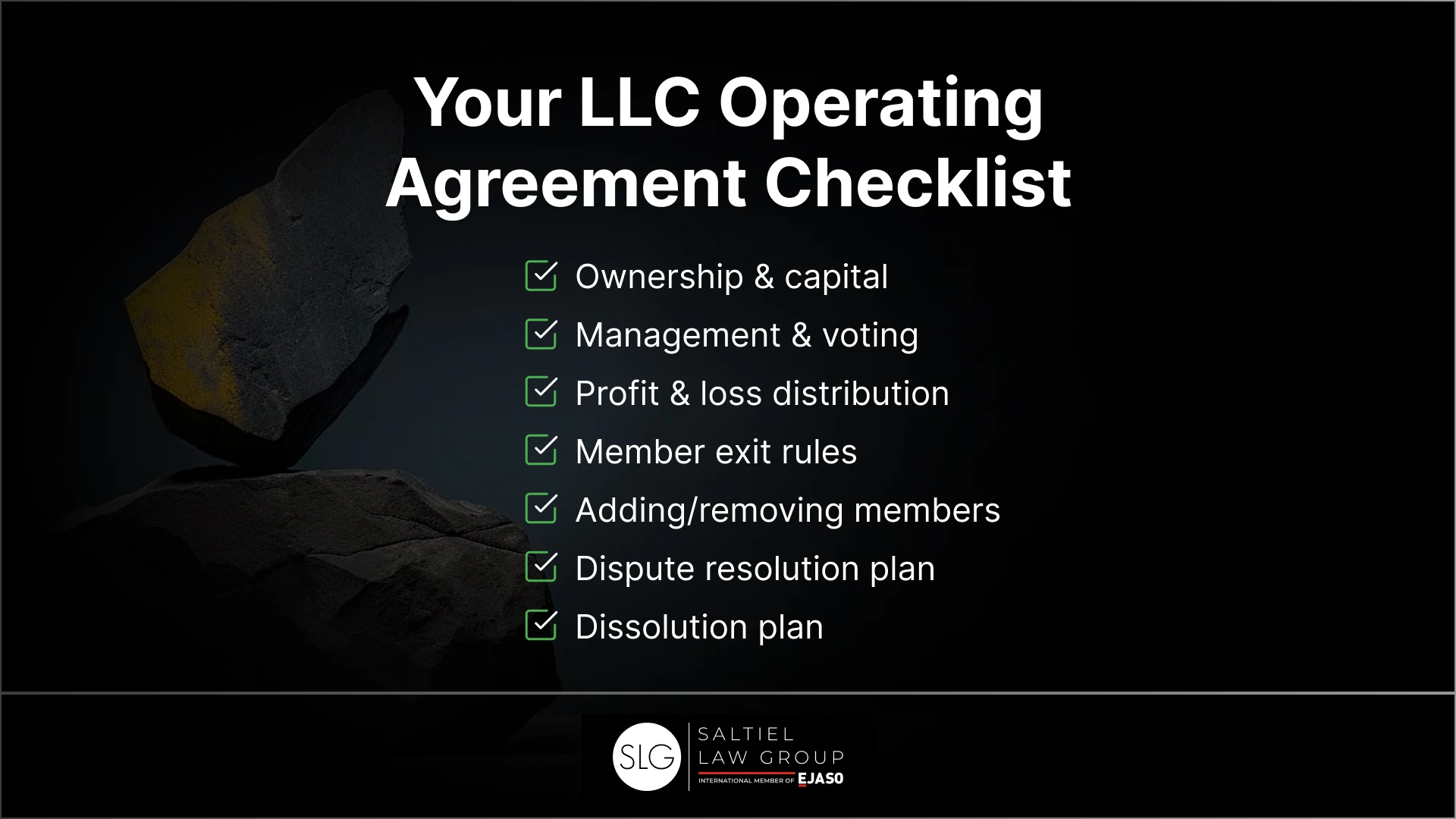
Core elements typically include:
- Ownership percentages and capital contributions
- Management structure and decision-making processes
- Profit and loss distribution methods
- Rules for transferring LLC membership interests
- Procedures for adding new members or removing existing ones
- Dissolution terms and exit strategies
The absence or poor drafting of an operating agreement rarely causes immediate problems. Instead, it tends to surface at the worst possible moment: during disputes, investor negotiations, regulatory scrutiny, or a contemplated sale of the business.

Is an LLC Operating Agreement Required in Florida?
Florida doesn't legally require LLCs to maintain written operating agreements. Yet operating without one resembles driving without insurance — technically possible but incredibly risky. Florida statutes fill the gaps when no agreement exists, but these default rules often create more problems than they solve.
From a business perspective, the real question is not whether Florida requires an operating agreement, but whether business owners are willing to let statutory defaults dictate control, economics, and exit rights when real value is at stake.
Single-member LLCs face unique considerations. While only one person owns the business, a written agreement still provides real benefits:
- Reinforces limited liability status by showing separation between owner and entity.
- Establishes business credibility with banks and investors who want to see proper documentation.
- Documents ownership if the sole member becomes incapacitated.
- Provides clear succession planning for the member's death.
- Helps secure business bank account access (many banks won't open accounts without one).
Multi-member LLCs absolutely need comprehensive agreements. Without written terms, members risk:
- Unintended profit-sharing arrangements under state law
- Inability to remove problematic members
- Forced dissolution upon any member's departure
- Endless disputes over management authority
- Personal liability exposure from piercing the corporate veil
Types of LLC Operating Agreements
As businesses grow, add partners, attract capital, or operate across borders, the operating agreement evolves from a formality into a governance and risk-management instrument.
Florida LLCs can structure their operating agreements in various ways, depending on management preferences and business needs. Understanding these different types helps you pick the structure that fits your company's goals.
Single-Member Operating Agreements
Single-member LLCs require special attention to maintain limited liability protection. These agreements must demonstrate clear separation between the individual and the business entity.
Key provisions focus on:
- Succession planning
- Incapacity procedures
- Maintaining corporate formalities

Multi-Member Operating Agreements
Multi-member agreements address the complexities of shared ownership. These documents must strike a balance between competing interests while providing precise governance structures.
Essential elements include:
- Voting procedures
- Profit allocations
- Exit strategies for departing members
Member-Managed Operating Agreements
Member-managed structures give all owners direct control over daily operations. This approach works well for smaller LLCs where members want active involvement.
The agreement should specify:
- Unanimous consent vs. simple majority for decisions
- Member responsibilities and time commitments
Manager-Managed Operating Agreements
Manager-managed agreements separate ownership from operational control. Members appoint managers to handle daily operations while retaining authority over fundamental decisions.
The agreement must carefully delineate:
- Manager authority limits
- Member oversight rights
- Compensation, removal procedures, and performance standards
Series LLC Operating Agreements
Florida allows Series LLCs, where one umbrella LLC creates separate series or cells, each with distinct assets and liabilities.
This complex structure requires:
- Coordination of inter-series relationships
- Liability shields between series
#cta_start
Address Cross-Border Tax Issues in Your Operating Agreement
Spanish and Latin American companies with Florida LLCs need provisions coordinating US tax obligations with home country reporting requirements. We'll draft terms preventing double taxation problems.
#cta_end
Pros and Cons of Operating Agreements
Most disputes involving LLCs are not caused by bad intent, but by silence — issues the operating agreement never addressed because they felt unlikely or uncomfortable at the time of formation.
Creating a comprehensive operating agreement requires upfront investment but delivers substantial long-term value. Understanding both benefits and challenges helps you decide about the level of detail your LLC needs.
Advantages of Comprehensive Operating Agreements
Well-drafted operating agreements transform verbal understandings into enforceable contracts, protecting both the business and its members.
Primary benefits include:
- Complete control over operations rather than relying on state default rules.
- Protection of limited liability status through proper corporate formalities.
- Clear dispute resolution procedures preventing expensive litigation.
- Flexibility to adapt ownership interests as the business grows.
- Enhanced credibility with lenders and potential investors.
- Tax planning opportunities through creative profit allocations.
- Succession planning protecting the business beyond the original members.
Banks and investors view comprehensive operating agreements as signs of serious business management. The document shows that members have considered various scenarios and created frameworks for handling them. This preparation often translates into better financing terms and stronger business relationships.
In transactions, buyers and investors do not view operating agreements as formalities. They view them as indicators of governance maturity, internal alignment, and risk discipline.
Potential Drawbacks of Operating Agreements
Despite their importance, operating agreements do present certain challenges that businesses must weigh against the benefits:
- Initial legal costs for proper drafting
- Time investment in negotiating terms with co-members
- Ongoing maintenance as business circumstances change
- Complexity in addressing all potential scenarios
- Possible restrictions on individual member actions
The biggest drawback involves anticipating future scenarios. No agreement can address every possible situation, and overly detailed provisions sometimes create unintended restrictions. Striking the right balance between comprehensive coverage and operational flexibility requires careful consideration and often professional guidance.
But even an imperfect operating agreement provides far better protection than relying on Florida's generic statutory defaults.
Main Provisions to Include in an LLC Operating Agreement
A well-drafted operating agreement addresses every aspect of LLC operations, preventing ambiguity that can lead to disputes.
Ownership Interests and Capital Contributions
Start by documenting each member's ownership percentage and initial investment. Beyond cash contributions, members might contribute services, property, or intellectual property.
Key considerations include:
- Valuation methods for non-cash contributions to avoid future disputes.
- Service requirements and vesting schedules if members contribute services.
- Address whether members are required to make additional capital contributions if needed, and outline the consequences if they refuse.
- Procedures for admitting new members, restrictions on transferring LLC interests, and buy-sell provisions triggered by death, disability, or departure.
Management and Voting Rights
Define who makes which decisions and how votes are counted. While ownership percentages often determine voting power, some LLCs adopt different arrangements.
Important provisions to include:
- Major decisions requiring supermajority approval while routine matters need only simple majority.
- Specific actions requiring heightened approval like incurring debt or selling substantial LLC assets.
- Deadlock scenarios addressed, especially in 50-50 partnerships, with options like mandatory mediation or buyout triggers.
Profit and Loss Allocations
Florida law allows LLCs to divide profits and losses in creative ways. The agreement should specify:
- Distribution timing and amounts: Whether profits will be distributed regularly or reinvested in the business.
- Tax distributions: Ensuring members can pay their share of tax obligations, even if the LLC retains earnings.
- Special allocations must have a "substantial economic effect" under IRS rules. Consult tax advisors to ensure compliance.
Transfer Restrictions and Exit Strategies
Without transfer restrictions, members might sell their interests to anyone, potentially bringing unwanted partners into your business.
Key provisions include:
- Right of first refusal for existing members
- Prohibition on transfers to competitors
- Approval requirements for new members
- Valuation formulas for buyouts and payment terms
- Non-compete obligations for departing members

How to Create and File Your Operating Agreement
Creating an effective operating agreement requires thoughtful planning and attention to detail.
Drafting Your Agreement
When drafting your operating agreement, consider Florida statutory provisions to ensure your LLC complies with state law. Florida LLCs are governed by the Florida Limited Liability Company Act (Chapter 605 of the Florida Statutes), which provides a basic framework. However, Florida's default rules are often too generic and might not suit your specific needs.
Key drafting steps:
- List all members and their initial contributions
- Decide management structure and decision-making processes
- Determine profit distribution methods
- Address member changes and exit scenarios
- Include dispute resolution procedures
- Add state-specific provisions for Florida LLCs
Avoid common template pitfalls like inconsistent terminology, missing Florida-specific requirements, or provisions that contradict your LLC's articles of organization. Legal counsel ensures your agreement actually protects your interests.
Brazilian companies forming Florida LLCs often use templates drafted for other states. These miss Florida-specific provisions and sometimes include language that conflicts with Florida law.
Execution Requirements
Florida doesn't require operating agreements to be notarized, but proper execution remains critical. All members must sign the agreement, preferably on the same day. While oral agreements are technically valid, proving their terms becomes nearly impossible during disputes.
Best practices include:
- Having all members sign multiple originals
- Dating the agreement to match or follow the LLC formation
- Storing copies in multiple secure locations
- Providing each member with a fully executed copy
- Updating signature pages when members change
Filing and Storage
Unlike LLC articles of organization filed with the Florida Department of State, operating agreements remain private internal documents. You don't file them with any government agency, which provides confidentiality but requires careful storage and handling.
The LLC should maintain the original in its official records, accessible to all members but protected from loss. Consider storing digital copies securely in the cloud as a backup. Banks, landlords, or major vendors might request copies to verify member authority — redacted versions can protect sensitive financial terms while providing necessary information.
Spanish and Latin American companies sometimes confuse US operating agreement privacy with home country publication requirements. In Spain, certain company documents get filed publicly. In Florida, your operating agreement stays private.

Operating Agreement Cost Considerations
Operating agreement costs vary dramatically based on complexity and customization needs. Basic single-member LLC agreements typically cost a few hundred dollars, while sophisticated multi-member agreements with complex equity structures can range from several thousand to tens of thousands.
Consider this investment in light of potential litigation costs — even simple business disputes often exceed $50,000 in legal fees. The right agreement prevents most conflicts from arising, making upfront costs minimal compared to protected value. Many businesses update agreements annually as they grow, budgeting ongoing legal review as a regular business expense.
Common Pitfalls and How to Avoid Them
Even well-intentioned business owners stumble when creating operating agreements. Learning from others' mistakes saves time and prevents future problems.
Using Generic Templates Without Customization
Free internet templates seem attractive, but they rarely address your specific situation. These one-size-fits-all documents often contain provisions that hurt rather than help. A California template may include community property language that is irrelevant to Florida businesses. Worse, generic forms miss opportunities to use Florida law's flexibility in structuring your LLC.
Customization extends beyond filling in blanks. Your business model, growth plans, and member relationships all influence optimal agreement terms. That tech startup needs different provisions than a real estate investment LLC or family business.
Forgetting to Update After Major Changes
Business evolution requires agreement updates. Adding new members, changing from a member-managed to a manager-managed structure, or pivoting business models all require revised documentation. Outdated agreements create confusion when their terms no longer match reality.
Schedule annual reviews to assess needed updates. Major events triggering immediate revisions include:
- Member additions or departures
- Significant capital structure changes
- Business model pivots
- Creation of subsidiaries
- Changes in tax elections
Colombian or Mexican companies expanding Florida operations often forget to update their operating agreements when they add US-based partners or change business focus.

Ignoring Tax Implications
Operating agreements significantly impact LLC taxation. Poorly drafted profit-sharing provisions might trigger unexpected tax bills or result in the loss of valuable deductions. Special allocations must satisfy complex IRS rules or risk recharacterization.
Partnership taxation allows tremendous flexibility but requires careful planning. Consider how different scenarios affect members' tax obligations — equal profit sharing might seem fair until members face vastly different tax brackets.
Spanish companies with Florida LLCs need careful coordination between US tax obligations and Spanish tax reporting requirements. The operating agreement should address this complexity.
Failing to Address Worst-Case Scenarios
Optimism during LLC formation often prevents addressing potential disasters. Nobody wants to consider member death, disability, bankruptcy, or bitter fallings-out when starting a business venture. Yet these events destroy unprepared LLCs.
Comprehensive agreements tackle uncomfortable possibilities head-on. What happens if your co-founder develops addiction issues affecting business judgment? How do you remove a member who stops contributing? Who runs the LLC if the sole manager becomes incapacitated? Planning for disasters prevents them from destroying your business.
Your LLC Operating Agreement: Foundation for Growth
A well-drafted operating agreement protects personal assets, clarifies member rights, and establishes dispute resolution mechanisms before conflicts arise. Business owners who address governance proactively position their companies to handle growth events, ownership transitions, and internal disagreements with greater certainty.
For businesses that intend to grow, attract capital, or preserve long-term value, a well-drafted operating agreement is not optional. It is one of the earliest — and most consequential — strategic decisions business owners make.
Saltiel Law Group's business attorneys craft custom operating agreements matching your specific goals and circumstances. Contact us today to build the legal foundation your Florida LLC deserves — because your business success depends on more than good intentions! Schedule a consultation to create an operating agreement that actually protects your business interests.

Tailored to You