


Commercial Contract Disputes: Miami Business Litigation Dos and Don'ts
In our experience working with businesses across Miami, Latin America, and Spain, one reality becomes clear: commercial disputes rarely begin with dramatic events. More often, they start quietly — through delayed payments, shifting expectations, or disagreements that seemed manageable at first.
At Saltiel Law Group, our Miami business litigation attorneys handle business disputes ranging from shareholder conflicts to construction matters. Over the years, we've helped companies of all sizes navigate conflicts involving partners, distributors, clients, employees, and cross-border affiliates. We've seen how the right strategy can protect what a business has built, and how the wrong early decisions can limit options for months or even years.
Our goal is simple: to help Miami businesses and the international companies that operate here handle disputes with clarity, preparation, and confidence.
What Miami Business Litigation Actually Covers

Business litigation encompasses shareholder disputes, trade secret violations, construction litigation, and officer liability claims. In Miami's commercial environment, these cases encompass shareholder disputes, trade secret violations, construction litigation, and officer liability claims.
A dispute influences business relationships, investor confidence, the company's reputation, leverage in negotiations, operational stability, and valuation in a future merger or acquisition.
Whether you're defending against business torts or pursuing breach of contract damages, you need attorneys who grasp both the legal mechanics and the business realities at stake.
For international companies, the stakes extend across borders. A dispute in Miami can affect operations in Bogotá, Madrid, São Paulo, Monterrey, or Lima.
- Documentation standards differ: Spanish- or Portuguese-language materials may require certified translation. Mexican companies operating Miami subsidiaries should document communications in both English and Spanish, keeping originals of all translated documents.
- Communication norms vary: Informal agreements or conversational approvals common in LATAM may be insufficient evidence in U.S. courts. Brazilian business partners need contemporaneous records of decisions made during video conferences across time zones.
- Enforcement rules create gaps: Cross-border contracts, currency issues, international arbitration clauses, and foreign judgment enforcement all require specific expertise. A Colombian company suing a Miami distributor for breach needs counsel who understands both jurisdictions.
Litigation is not simply a legal event. It's a business event that must be managed strategically.
DOs: What Miami Businesses Should Prioritize in Contract Disputes

Your approach from the beginning often determines whether your case wraps up quickly or drags on for years.
1. Document Everything from the Start
The foundation of any strong case rests on comprehensive documentation. In Miami litigation, the written record often determines the outcome.
Businesses should maintain:
- Emails and internal messages: Save all written correspondence related to your business disputes. These documents often become the deciding factor in both bench trials and jury trials.
- WhatsApp or SMS communications: Common in Latin American business, these count as evidence and must be preserved. Spanish companies using Slack or Microsoft Teams need proper data preservation protocols.
- Contract versions and amendments: Record dates, times, and attendees of meetings where contract terms got discussed. International companies, in particular, benefit from keeping bilingual copies of key documents.
- Financial records: Maintain organized files of invoices, purchase orders, and payment records for accurate and timely access.
A clear record builds leverage long before litigation begins.
2. Choose Counsel Who Understands Both the Law and the Business Context

Timing matters when selecting your legal team. Every dispute sits at the intersection of legal exposure and business strategy.
Effective litigation counsel understands your industry, the commercial relationship behind the dispute, the financial implications for the business, cross-border dynamics, and how litigation might affect long-term objectives.
Effective litigation counsel understands:
- Your industry
- The commercial relationship behind the dispute
- The financial implications for the business
- Cross-border dynamics, and
- How litigation might affect long-term objectives
A good litigator protects your legal rights. A great one protects your business interests.
3. Align Litigation Strategy with Business Goals
Litigation should always serve the company's broader strategy, not overshadow it. Before filing or responding to a lawsuit, companies should ask:
- Will this dispute harm a key business relationship?
- How will it affect investors or potential buyers?
- Could mediation or negotiation preserve value?
- What outcome best protects the company long-term?
Colombian exporters suing Miami importers over payment disputes need to consider whether winning the lawsuit costs them their entire US market access. Peruvian manufacturers facing quality claims from Florida distributors should weigh litigation costs against potential contract renegotiation.
4. Preserve Evidence Immediately
Once litigation becomes likely, immediately preserve all relevant documents and electronic data. Notify employees about litigation holds to prevent destruction.
Failing to preserve evidence can lead to sanctions and damage your credibility with the court. For companies operating across borders, coordinating evidence preservation across teams and time zones is essential.
Mexican companies with operations spanning Monterrey and Miami need coordinated litigation holds across both locations. WhatsApp communications (common in Latin American business) count as evidence and must be preserved. Spanish companies using Slack or Teams need proper data preservation protocols that capture all relevant channels.
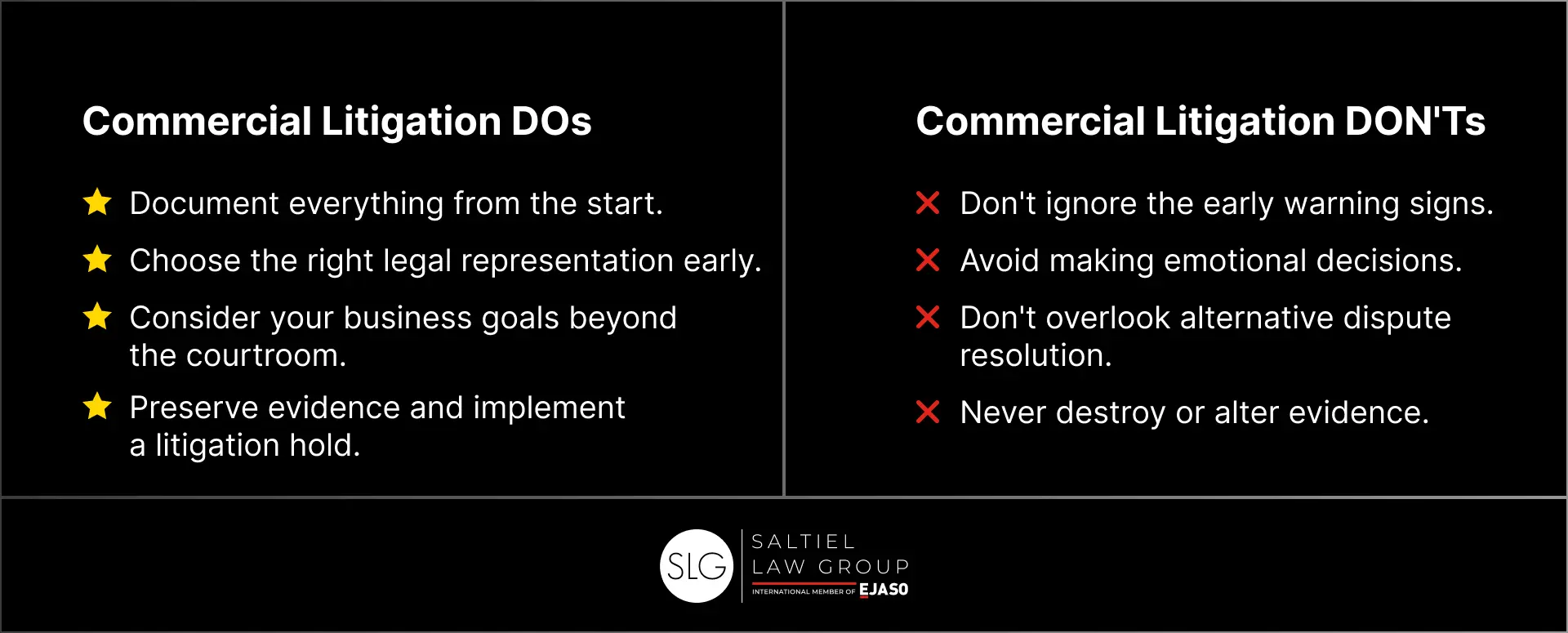
DON’Ts: The Mistakes That Turn Manageable Conflicts into Major Litigation
Many commercial litigation cases go sideways due to preventable errors. These missteps can transform winnable cases into expensive losses.
1. Don't Ignore Early Warning Signs
Business disputes rarely emerge overnight. Red flags often appear long before a lawsuit.
Red flags often appear long before a lawsuit:
- Repeated payment delays or disputes over invoicing: Brazilian companies noticing sudden payment pattern changes from Miami customers should investigate right away.
- Сhanges in communication patterns with business partners: Spanish joint venture partners experiencing communication breakdowns with Florida counterparts need to address issues before positions harden.
- Requests for contract modifications that favor one party: These often signal deeper disagreements about contract interpretation or performance obligations.
- Unexplained departures of personnel with access to confidential information: This can indicate disputes over trade secrets, intellectual property, or competitive restrictions.
Addressing issues early often prevents escalation. Acting promptly when these red flags appear can prevent minor disagreements from escalating into complex commercial disputes requiring extensive litigation.
2. Don’t Allow Emotion to Drive the Strategy

Business litigation often triggers strong emotions, particularly in cases involving former partners or broken trust. However, the strongest outcomes come from measured and strategic decision-making.
Colombian family businesses facing partnership disputes in Miami sometimes let personal relationships cloud business judgment. Mexican entrepreneurs dealing with IP theft by former employees need to separate emotional responses from strategic litigation decisions.
3. Don't Overlook Alternative Dispute Resolution
While some cases demand aggressive litigation, many disputes resolve more efficiently through mediation or arbitration. These alternative paths often save substantial time and legal costs while preserving confidentiality.
Alternative dispute resolution can protect confidentiality, reduce expenses, preserve business relationships, and deliver faster outcomes. For cross-border agreements, arbitration may even be required. Not every conflict belongs before a judge.
4. Never Destroy or Alter Evidence
Even unrelated document destruction can appear suspicious once litigation begins. Courts impose severe penalties for spoliation, including adverse jury instructions and monetary sanctions.
When in doubt, preserve more rather than less. Even accidental deletion can lead to severe consequences.
Mexican companies cleaning up old files should pause immediately when disputes pop up. Brazilian subsidiaries going through normal data retention cycles need litigation hold procedures that override standard deletion protocols. Spanish companies upgrading email systems during disputes must preserve all historical communications.
#cta_start
Evaluate Your Arbitration Strategy
If your contracts include Madrid, Mexico City, or other foreign arbitration clauses, we can help you determine whether enforcement serves your interests better than US litigation.
#cta_end
Litigation's Impact on Business Growth and Long-Term Value
A commercial dispute does not exist in isolation. It influences how brokers assess your readiness for a transaction, how investors perceive stability, your position in negotiations, and your valuation in a potential exit.
For companies considering M&A, litigation history matters:
- Active disputes signal risk: Buyers discount valuations when unresolved litigation threatens future operations or creates contingent liabilities.
- Resolution demonstrates capability: Handled correctly, a dispute becomes a sign of organizational maturity and sophisticated risk management.
- Documentation quality reflects systems: Strong litigation preparation often indicates broader operational excellence that buyers value.
Handled correctly, a dispute becomes evidence of business maturity. Handled poorly, it becomes a red flag that follows the company for years.
How Saltiel Law Group Approaches Commercial Disputes

Our Business Litigation & Dispute Resolution Team evaluates exposure early, determines whether litigation, negotiation, or arbitration is appropriate, coordinates bilingual and cross-border evidence preservation, manages disputes in Florida state and federal courts, enforces foreign arbitration clauses, and negotiates resolutions aligned with long-term business health.
We approach litigation with a clear objective: to protect both the legal and commercial interests of the businesses we serve. Our team has helped companies across Miami, Latin America, and Spain navigate conflicts involving partners, distributors, clients, employees, and cross-border affiliates.
We've seen how the right strategy can protect what a business has built, and how the wrong early decisions can limit options for months or even years. This experience informs how we guide clients through disputes with clarity, preparation, and strategic focus.
Turning Litigation Strategy into Business Success
Commercial litigation in Miami demands more than legal knowledge. It requires strategic thinking about how each decision affects business relationships, market position, and long-term value. The difference between a favorable outcome and a costly loss often comes down to decisions made before stepping into a courtroom. Companies that treat litigation as a business event, managed with the same rigor they apply to operations and finance, consistently achieve better results while preserving more strategic options.
When disputes arise, having the right legal team makes all the difference. That is where Saltiel Law Group can make all the difference. Our team combines courtroom experience with business acumen, handling complex disputes for companies throughout South Florida, including Spanish and Latin American businesses operating in Miami.
Schedule a consultation to discuss your situation and determine the strategic approach that best protects your business interests.

Tailored to You